
Teaching Chess to Youth: Why Ulamaify’s Guided Chess Education Can Matter Beyond the Board
When it comes to teaching chess to youth, knowing how the pieces move is easy. However, teaching a young person how to actually think through a complex position is something very different.
A child can learn the basic rules of chess quickly: bishops move diagonally, rooks move in straight lines, knights jump, pawns advance, and the king must be protected.
But the real work of teaching chess to youth begins after the rules.
It begins when a teacher asks:
What do you notice?
What is your opponent trying to do?
What possibilities do you have?
Why would you choose this move instead of another?
What changed after your move?
Those questions help explain why teaching chess to young people can have value well beyond simply producing stronger chess players.
Teaching Chess to Youth: Building Critical Thinking Habits Early
Executive-function abilities—including working memory, flexible thinking, attention, planning, and self-control—continue developing through childhood and adolescence.
The Center on the Developing Child at Harvard University explains that these abilities help us manage information, make decisions, focus attention, switch strategies, and plan ahead. Children are not born with fully developed executive-function skills; they develop through experience and practice over time.
That makes childhood and adolescence particularly important periods for giving young people meaningful opportunities to use these abilities.
Chess is one possible environment for doing exactly that.
Every meaningful position asks the learner to coordinate several mental processes simultaneously.
The student remembers previous ideas.
They examine the current position.
They control the impulse to move immediately.
They predict possible responses.
They select a plan.
Then the position changes—and they must think again.
Playing Chess and Being Taught Chess Are Not the Same Thing
A child can play hundreds of games while repeating the same mistakes.
Experience alone does not guarantee learning.
The educational value becomes much stronger when someone helps the learner reflect on what happened.
Consider two responses to the same mistake.
The first is:
“That was a bad move.”
The second is:
“Before you moved, what were you looking at? What threat did your opponent have? What could you check next time?”
The first response identifies an error.
The second helps build a process.
This distinction is important because some research on teaching chess to youth suggests that the way chess is taught may influence whether learners develop skills beyond simply becoming better chess players.
Researchers reviewing chess education have cautioned against assuming that playing chess automatically transfers to broad academic abilities.
That means good instruction should deliberately teach the thinking habits we want children to practice.
Chess Can Teach Children to Explain Their Thinking
One powerful feature of teaching chess is that a child’s thinking becomes visible.
A teacher can point to a position and ask:
“What would you play?”
But the more valuable question may be:
“Why?”
When children explain a move, they must organize their reasoning.
“I want to attack the queen.”
“I am protecting my king.”
“If he captures this piece, I can capture that one.”
“I considered moving here, but then my rook would be unprotected.”
The child is no longer merely producing an answer.
They are examining their own thought process.
Research has explored this connection with metacognition—the ability to think about and regulate one’s own thinking. In one study, students receiving chess instruction over six months showed greater improvement in metacognitive abilities and mathematical problem-solving than students in the comparison group.
That does not prove that every chess lesson will produce the same result.
It does suggest something useful for educators:
How we discuss the game may matter as much as the game itself.
A Chess Lesson Can Make Failure Safe
When teaching chess to youth, players need challenges difficult enough to produce mistakes but safe enough that mistakes do not become frightening.
Chess is exceptionally good at creating small failures.
A tactic is missed.
A piece is lost.
A plan fails.
A winning position turns into a draw.
A game ends in defeat.
Then the pieces are reset.
The student gets another opportunity.
With supportive instruction, this cycle can teach a healthier relationship with error.
Instead of:
“I failed.”
The question becomes:
“Where did the position change, and what can I learn from it?”
Research published in The Spanish Journal of Psychology followed children and adolescents involved in chess and reported positive differences in areas including cognitive abilities, coping, problem-solving, and socio-affective development compared with participants in other extracurricular activities. The researchers also emphasized that student characteristics influenced some outcomes, reminding us that no extracurricular activity affects every child identically.
The coach’s role is therefore important.
Correcting without embarrassing.
Challenging without overwhelming.
Helping the student see improvement without making winning the only measure of success.
Chess Teaches That Decisions Have Consequences
In many areas of childhood, adults protect children, but teaching chess to youth creates a rare environment where consequences are real but harmless.
That protection is often necessary.
Chess creates a rare environment where consequences are real but harmless.
Move a defender away and something may become vulnerable.
Attack before developing your pieces and your king may become unsafe.
Ignore the opponent’s plan and you may lose material.
The child experiences cause and effect directly.
Nobody needs to lecture them about it.
The board shows them.
This is one reason a thoughtful chess teacher continually asks students to examine both sides of the position.
Not only:
“What do you want?”
But also:
“What does the other player want?”
That small shift encourages perspective-taking and anticipation.
Chess Can Challenge Children at the Right Level
An activity becomes frustrating when it is far too difficult and boring when it is far too easy.
Chess has an unusually large range of difficulty.
A beginner may be working on keeping pieces protected.
Another child may be learning a basic checkmate.
An intermediate student may calculate a three-move tactic.
An advanced student may compare long-term strategic plans.
This is the beauty of teaching chess to youth: the board remains the same while the depth of the challenge changes.
The 2025 Frontiers in Psychology study on young chess learners also notes that activities intended to support executive functions are more useful when they are practiced regularly, remain appropriately challenging, and maintain children’s motivation.
That supports a fundamental principle of good youth education: children benefit from challenges that meet them where they are and then gradually ask more of them.
Why Teaching Chess to Youth Can Become Social Learning
Chess is often imagined as a solitary game. However, teaching chess to youth does not have to be a lonely experience.
In a small group, one position can produce several ideas.
One student chooses a move.
Another disagrees.
A third notices a threat neither of them saw.
The teacher asks each child to explain.
Suddenly chess becomes a conversation.
Children learn that another person’s reasoning can be different without necessarily being foolish. They discover that an idea can be questioned without attacking the person who proposed it.
That makes the classroom itself part of the learning experience.
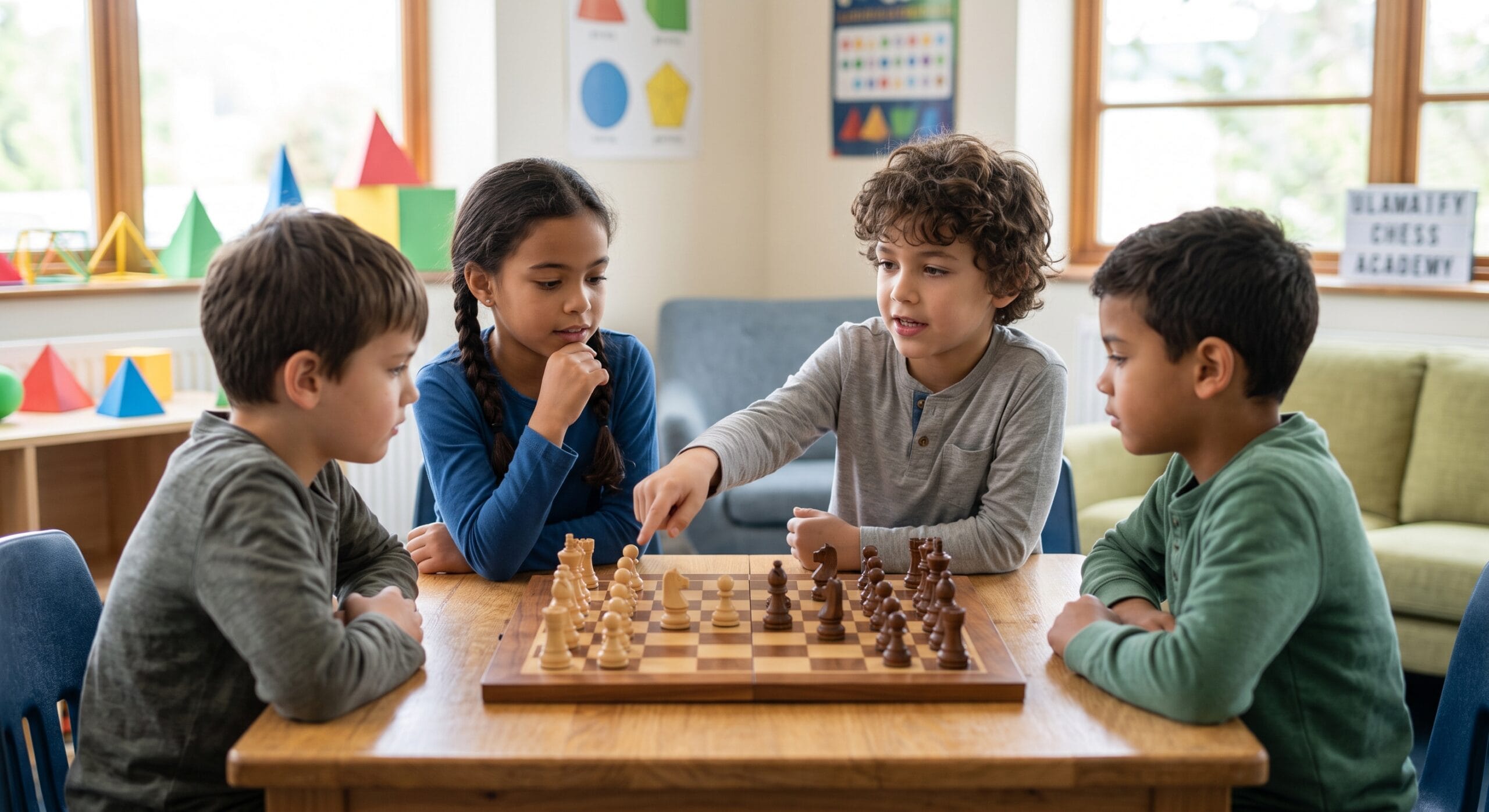
At Ulamaify Chess Academy, classes are live and capped at four students. The small-group format is intended to give children room to solve, suggest moves, explain their thinking, play, and reflect while allowing the coach to notice how each child approaches the game.
What Does the Research Actually Say?
There is a temptation in chess marketing to make very large promises.
“Chess raises IQ.”
“Chess guarantees higher math scores.”
“Chess makes children smarter.”
The evidence is more nuanced.
A meta-analysis of chess education research found modest positive average effects in cognitive and academic measures, but the researchers warned that many underlying studies had limitations and that placebo effects and study design made strong causal claims difficult.
A particularly large randomized study in England involving 100 schools and 4,009 pupils found no evidence that approximately 30 hours of school chess instruction produced higher mathematics, reading, or science scores one year after the intervention.
More recently, a study of 88 five- and six-year-olds found significantly higher visuospatial working-memory scores among children attending chess classes, although the study design could not establish definitive causation.
Together, these findings suggest a reasonable conclusion:
Chess should not be sold as academic magic.
It should be taught well because chess itself is a rich environment for practicing attention, memory, planning, calculation, reflection, problem-solving, emotional recovery, and decision-making.
The Goal Is Not Simply a Better Chess Player
Of course children who study chess should become better at chess.
They should understand tactics.
They should learn strategy.
They should recognize patterns.
They should know how to finish a winning game.
But teaching chess to youth can aim much higher than simply gaining rating points.
A thoughtful chess teacher can help a student develop a routine:
Look before acting.
Ask questions.
Consider alternatives.
Explain your reasoning.
Accept feedback.
Recover after mistakes.
Try again with better information.
Those are habits worth practicing.
At Ulamaify, that is why we describe chess as more than learning where pieces move.
We want children to practice how thoughtful decisions are made.
When chess is taught that way, the board becomes more than a game board.
It becomes a classroom for thinking.
Research and Further Reading
Center on the Developing Child at Harvard University — Executive Function
https://developingchild.harvard.edu/resource-guides/guide-executive-function/
Sala, Foley & Gobet — The Effects of Chess Instruction on Pupils’ Cognitive and Academic Skills
https://www.frontiersin.org/journals/psychology/articles/10.3389/fpsyg.2017.00238/full
Aciego, García & Betancort — Intellectual and Social-Emotional Enrichment in Schoolchildren
https://www.cambridge.org/core/journals/spanish-journal-of-psychology/article/benefits-of-chess-for-the-intellectual-and-socialemotional-enrichment-in-schoolchildren/9BAE7D7E2A9D7587C0259F7E964E5CF9
Kazemi, Yektayar & Mohammadi Bolban Abad — Chess, Metacognition and Mathematical Problem-Solving
https://www.sciencedirect.com/science/article/pii/S1877042812000572
Education Endowment Foundation — Chess in Primary Schools
https://educationendowmentfoundation.org.uk/projects-and-evaluation/projects/chess-in-primary-schools
Ulamaify Chess Academy
https://ulamaify.com/chess-ulamaify/
What makes Ulamaify’s approach to teaching chess to youth different?
Ulamaify goes beyond teaching rules and correct moves. Students are encouraged to solve, explain, compare ideas, play, and reflect, helping the coach focus on how each child thinks through a position.
Why are Ulamaify Chess classes limited to four students?
The four-student maximum gives each child more opportunities to participate, explain their reasoning, ask questions, and receive personal guidance from the coach.
It also allows students to learn from the different ideas and approaches of their classmates without getting lost in a large group
How does Ulamaify help children learn from chess mistakes?
Coaches use mistakes as opportunities for reflection rather than simply labelling a move as wrong.
Students may be asked what they noticed, what they expected to happen, what they overlooked, and what they could check next time. This helps turn a mistake into a useful learning step.
Does Ulamaify focus only on making children better chess players?
No. Improving chess ability is an important part of the program, but Ulamaify also gives children opportunities to practice attention, planning, problem-solving, explaining their reasoning, adapting to changes, and reflecting on decisions while learning the game.
Does research prove that teaching chess makes children smarter?
No. Research does not support claims that chess automatically raises IQ or guarantees better academic performance.
Some studies have found encouraging results in areas such as working memory, problem-solving, and executive-function skills, while other research has found limited transfer to school achievement. That is why Ulamaify follows a research-without-the-hype approach and focuses on the thinking skills children actually practice during well-guided chess lessons.

Add your first comment to this post