
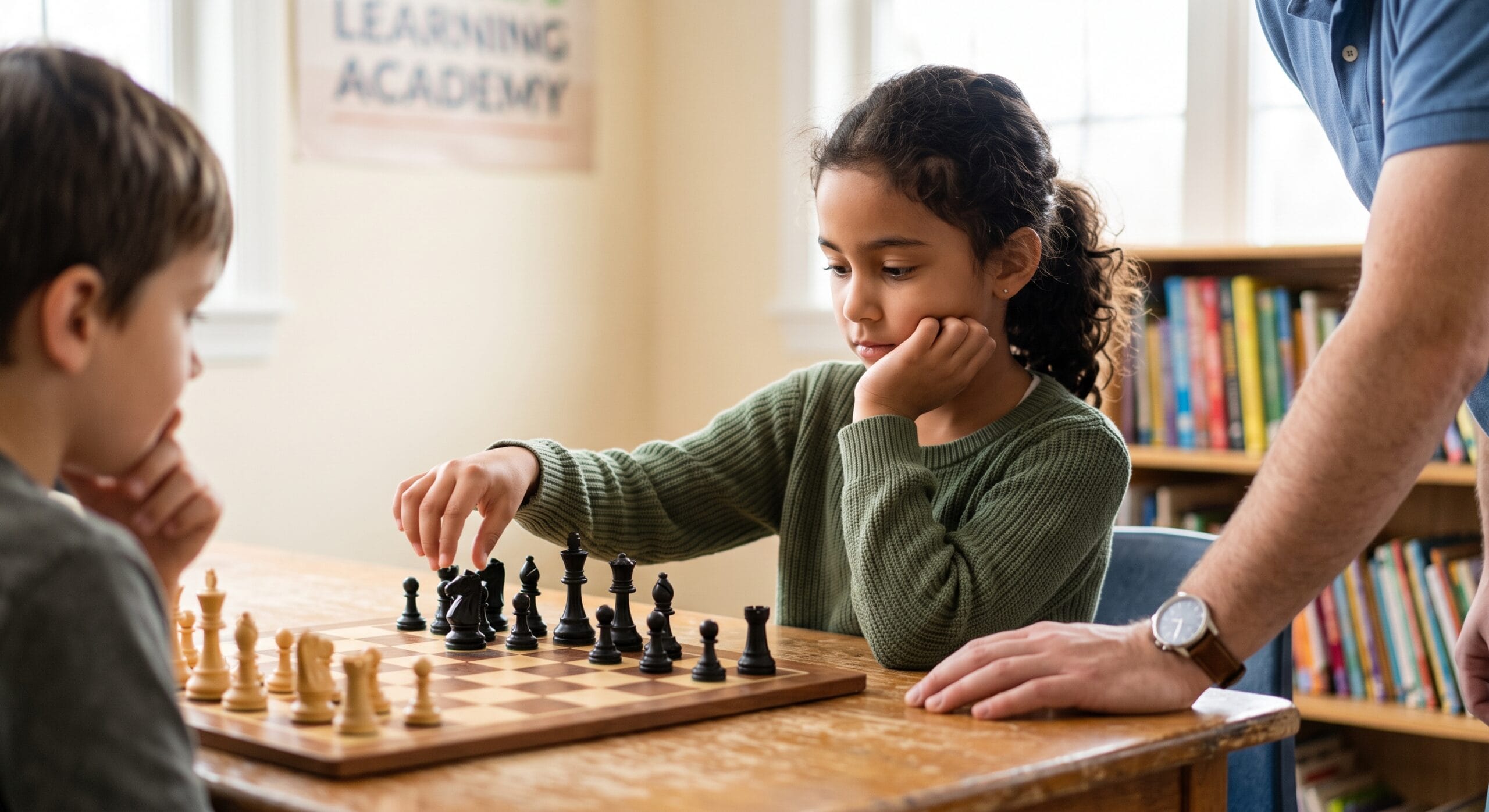
Chess and Decision Making: How Ulamaify Helps Children Think Before They Move
The connection between chess and decision making can begin with one very small moment.
A child reaches toward the chessboard.
They see a move they like.
Maybe it attacks the queen.
Maybe it gives check.
Maybe it simply looks exciting.
Then an Ulamaify coach asks:
“Before you move—what else could happen?”
The hand stops.
The child looks at the board again.
That small pause captures much of what we want children to practice through Ulamaify Chess Academy.
Not because choosing the right bishop move will somehow solve real-world problems.
It matters because, for a moment, the child practices creating space between impulse and action.
At Ulamaify Chess Academy, we organize that process into a simple thinking routine:
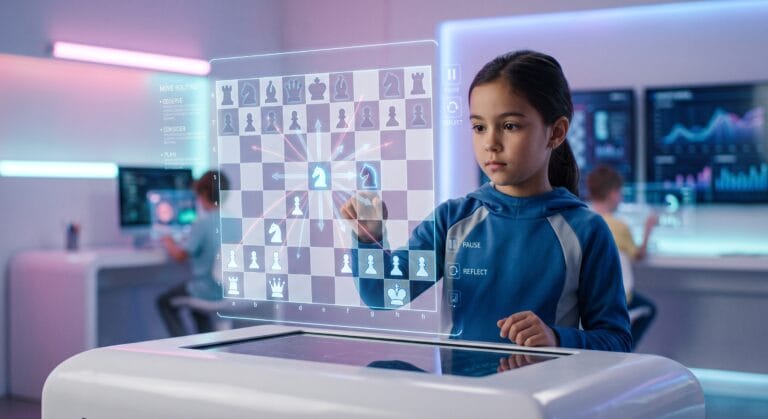
Pause → Observe → Consider → Plan → Move → Reflect.
The purpose is not to claim that every chess skill automatically becomes a life skill. Research on transferring skills from chess to unrelated areas is mixed, and broad claims should be treated carefully.
Our approach is more practical:
Create repeated, guided opportunities for children to practice thoughtful decisions while learning chess.
That is where Ulamaify connects chess and decision making.
Chess and Decision Making: Turning a Move Into a Thinking Process
Children can learn how the pieces move relatively quickly.
But knowing how a knight moves is very different from knowing when to move it, why to move it, what alternatives exist, and what might happen afterward.
That is where coaching begins.
During an Ulamaify class, children do not only watch an instructor demonstrate chess.
They solve, choose, explain, play, and reflect.
Classes are live and have no more than four students, which gives the coach an opportunity to hear why a child chose a move, notice where they hesitated, and ask the next question that can move their thinking forward.
Instead of simply saying:
“That move is wrong.”
a coach can ask:
“What were you expecting to happen?”
Instead of:
“Move your knight here.”
the coach can ask:
“What other moves did you consider?”
Instead of:
“You missed the threat.”
the question can become:
“What did your opponent’s last move change?”
The chess lesson therefore becomes more than finding answers.
It becomes practice in how to arrive at a decision.
Step One: How Ulamaify Teaches Children to Pause Before Acting
Young chess players often see an attractive move and want to play it immediately.
Adults do this too.
Something catches our attention, and action comes before enough thought.
Chess and decision making share a unique trait: consequences become visible very quickly.
A child sees a check.
They play it.
One second later, they realize their queen was unprotected.
That moment gives the coach something useful to work with.
At Ulamaify, Pause comes first in our thinking routine for a reason.
The goal is to help children create a brief moment between:
“I see it.”
and:
“I will do it.”
Our Chess Academy describes this directly as creating a moment between impulse and action.
Developmental researchers describe a related ability as inhibitory control or self-control, part of the broader family of executive-function skills. Harvard’s Center on the Developing Child explains that executive functions help people manage information, make decisions, plan, focus attention, and switch approaches when needed.
We do not tell parents that practicing this over a chessboard will automatically make a child perfectly self-controlled elsewhere.
Instead, Ulamaify provides repeated practice in a very specific behavior:
See something. Pause. Check. Then decide.
One chess position does not create a habit.
But a thoughtful coach can create many opportunities to practice one.
Step Two: How Ulamaify Helps Children Observe Before They Decide
After the pause comes another question:
“What is actually happening?”
Young players naturally focus on what they want.
“I want to attack.”
“I want the queen.”
“I want to checkmate.”
But chess contains another player with another idea.
So an Ulamaify coach may ask:
“What did your opponent’s last move change?”
That question shifts the child from intention to observation.
Maybe a piece became protected.
Maybe a threat appeared.
Maybe the opponent opened a line toward the king.
Maybe the child’s original plan no longer makes sense.
This is one reason live interaction matters when teaching chess and decision making.
A prerecorded video can explain a position.
An app can evaluate a move.
But during a live small-group lesson, a coach can respond to what this particular child noticed—or failed to notice—in this particular moment. Ulamaify classes are designed around that live guidance rather than children simply playing alone against software.
The broader thinking habit is simple:
Do not decide only from what you want. First understand the situation you are actually in.
That is a useful lesson within chess even before making any claim about life outside the board.
Step Three: How Ulamaify Helps Children Consider More Than One Possibility
A beginning player often asks:
“Is this move good?”
At Ulamaify, we can push the question one step further:
“What other move could you consider?”
Sometimes we may ask a child to find two or three candidate moves.
Now something important changes.
The child is no longer evaluating one idea in isolation.
They have to compare.
Which move is safer?
Which move creates a threat?
Which protects something important?
What could the opponent do against each option?
Which move helps the larger plan?
This is one of the clearest ways chess and decision making come together inside an Ulamaify lesson.
Good decision-making is not simply finding an option.
It often involves recognizing that there are alternatives.
This also connects with cognitive flexibility, one of the abilities commonly discussed as part of executive function.
Chess naturally requires flexibility because the position changes after every move.
An idea that made sense thirty seconds ago may no longer be appropriate.
The child has to look again.
Why the Four-Student Maximum Matters Here
This is also where the structure of the Ulamaify program matters.
In a very large online class, it is easy for one confident student to answer while everyone else watches.
That is not what we want.
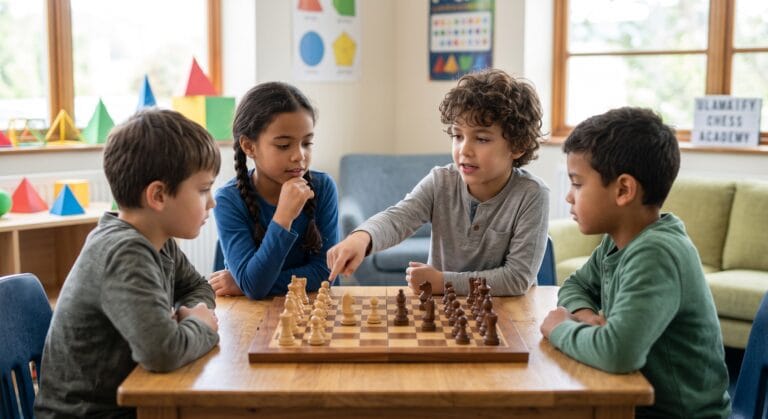
Ulamaify Chess classes have no more than four students. The purpose is to leave room for children to participate and for the coach to understand how each student is thinking.
One child may suggest an attacking move.
Another may prefer to defend.
A third may notice something both missed.
Instead of the teacher immediately announcing the answer, the group can compare ideas.
Why do you prefer that move?
What problem does it solve?
What could go wrong?
Does anyone see another possibility?
Now a chess lesson becomes a conversation about choices.
That is difficult to reproduce when a child is merely watching or clicking through exercises alone.
Step Four: How Ulamaify Teaches Children to Think About Consequences
Once children have several possibilities, the next question is:
“What happens if I choose this one?”
Chess makes consequences unusually visible.
Move a defender away and another piece may become vulnerable.
Begin an attack too early and the king may remain exposed.
Ignore a threat and the position can deteriorate.
Prepare carefully and a future opportunity may become possible.
The board responds to the decision.
At Ulamaify, this is where Plan enters the routine.
The child begins asking:
“If I do this, what might happen next?”
Then:
“And after that?”
Planning is therefore not simply predicting many moves.
It means thinking beyond the immediate action.
Our Chess Academy describes this habit as “Think beyond now.”
For a beginner, that might mean:
“Before I attack, should I protect my king?”
For another student:
“If I trade this piece, what will the position look like afterward?”
For a more advanced child:
“If my opponent prevents this plan, where else can I play?”
The complexity changes with the student’s level.
The thinking structure remains recognizable.
Ulamaify Helps Children Distinguish a Move From a Plan
A move answers:
“What will I do?”
A plan answers:
“What am I trying to accomplish?”
That difference can be difficult for children at first.
A student may say:
“My plan is to move my rook.”
The coach can ask:
“What do you want the rook to accomplish?”
Now the thinking becomes deeper.
Maybe the goal is to control an open file.
Maybe the goal is to pressure a weak pawn.
Maybe the rook needs to join an attack.
The move is no longer isolated.
It serves a purpose.
This is part of what Ulamaify is trying to teach when children explain their ideas rather than simply memorize moves.
The program specifically distinguishes its approach from memorization without understanding and emphasizes live guidance, conversation, and practice.
Step Five: Ulamaify Gives Children Practice Making Decisions Without Certainty
Eventually, the child has to move.
They can pause.
Observe.
Consider.
Plan.
But they still cannot know exactly what the opponent will do.
That is part of chess.
You analyze.
You compare.
You make the best decision you can.
Then another person responds.
This creates an important teaching opportunity.
In both chess and decision making, children sometimes judge a choice entirely by the final outcome.Children sometimes judge a decision entirely by the final outcome.
“I lost, so my move must have been bad.”
“I won, so everything I did must have been good.”
Chess quickly shows that the relationship is not always so simple.
A child can make a sensible decision and still lose the game.
A child can make a poor move and win because the opponent later makes a larger mistake.
An Ulamaify coach can therefore ask:
“Was the thinking reasonable based on what you knew at the time?”
That is a richer question than:
“Did you win?”
The goal is not to make outcomes meaningless.
Winning and losing are genuine parts of chess.
But we also want children to become interested in the quality of the process that produced their choice.
Step Six: How Ulamaify Uses Reflection to Turn a Game Into Learning
The final stage of the Ulamaify routine is:
Reflect.
That step is essential.
A child can play many games while repeating the same pattern.
Playing alone does not guarantee reflection.
After an important position, an Ulamaify coach can return to the moment and ask:
“What did you expect?”
“What actually happened?”
“What did you overlook?”
“What would you consider if you saw this position again?”
Now the game becomes something the child can study.
Ulamaify’s class structure explicitly includes a Reflect & Grow stage, where an important moment becomes the next learning step. Membership also includes guided Lichess practice and game analysis, giving students additional opportunities to revisit their play rather than only accumulate more games.
This relates to the idea of metacognition—examining and regulating one’s own thinking.
Research on chess instruction has investigated possible relationships between chess study, executive skills, metacognition, and problem-solving, while also warning that findings should not be stretched into claims of broad automatic cognitive improvement.
For Ulamaify, the practical lesson is straightforward:
Do not only tell a child what happened. Help the child understand how they arrived there.
How Ulamaify Makes Mistakes Useful
Children will make chess mistakes.
We expect that.
They will hang pieces.
Miss tactics.
Rush.
Forget plans.
Misjudge positions.
Lose games they could have won.
The question is what the learning environment does with those mistakes.
Ulamaify’s Chess Academy explicitly treats each game as a place where children can examine choices, recover from mistakes, test another idea, and try again. Coaches help children examine what happened and continue without embarrassment.
That distinction matters.
A child who hears:
“How could you miss that?”
may learn to fear mistakes.
A child who hears:
“Interesting. Let’s go back and see where the position changed.”
is given something to investigate.
The mistake becomes information.
This does not mean pretending losses do not matter.
It means making them useful.
How Ulamaify Creates a Safe Place to Practice Decisions
Children cannot safely practice every important real-world choice, which is why chess and decision making are so closely linked.
Many real choices carry consequences that are too significant for experimentation.
Chess offers something different.
Inside an Ulamaify lesson, a child can:
Make a decision.
See its consequence.
Discover that the plan did not work.
Try to recover.
Discuss what happened.
Reset the board.
Try again.
Nobody is seriously harmed by an inaccurate knight move.
But the child still experiences a meaningful cause-and-effect cycle.
That is why the Ulamaify Chess page describes the game as a safe place to examine choices, recover from a mistake, test a new idea, and try again.
The safety does not come only from the chessboard.
The coaching environment matters too.
A safe learning environment means mistakes are expected, questions are welcomed, and children can offer ideas without needing every answer to be correct.
With four students maximum, the coach can stay close enough to that process to guide it personally.
Why Losing Can Become a Valuable Ulamaify Lesson
Winning tells a child that something worked.
Losing often creates more questions.
What did I overlook?
Where did my plan stop working?
Did I rush?
Did I continue attacking when I should have defended?
Did I become frustrated after losing a piece?
Was there a better possibility?
At Ulamaify, the goal after a loss is not to turn every game into a long lecture.
Sometimes one important moment is enough.
The coach finds something the student can carry into the next game.
That could be:
“Before attacking, check your king.”
or:
“After your opponent moves, look at what changed.”
or:
“You lost a piece, but you kept looking for possibilities. Keep that.”
Now the next game has a purpose.
That is more useful than simply labeling the previous game a failure.
How Ulamaify Helps Children Notice the Habit Behind the Decision
This is one of the most important differences between simply playing chess and using chess intentionally as a learning environment.
We should not assume that a child will automatically notice the broader thinking habit.
The coach can make it visible.
For example:
“You saw a check but didn’t play it immediately. You looked first. That’s pausing before acting.”
“You found three possible moves before choosing. That’s comparing alternatives.”
“Your first plan stopped working and you changed it. That’s flexible thinking.”
“You went back to the position and discovered what you missed. That’s reflection.”
This is how Ulamaify helps children notice the habit behind the chess move.
Not by making exaggerated promises that every chess idea transfers automatically to daily life.
By naming the process while children are actually practicing it.
That distinction is consistent with research caution around “far transfer.” Reviews of chess education have found some promising results but also significant methodological limitations, and a large randomized Education Endowment Foundation trial did not find lasting gains in standardized mathematics, reading, or science results one year after its school chess intervention.
That is why Ulamaify’s stated approach is “Research, Without the Hype.”
We would rather clearly explain what children practice than promise what research cannot guarantee.
Chess and Decision Making Beyond the Board—Taught Intentionally
There are obvious parallels between the questions children encounter in chess and questions that appear elsewhere.
During chess:
“What changed?”
Outside chess:
“Do I understand the situation before responding?”
During chess:
“What other moves are possible?”
Outside chess:
“Do I have more than one option?”
During chess:
“What happens next?”
Outside chess:
“What could follow from this choice?”
During chess:
“My plan stopped working. What now?”
Outside chess:
“New information appeared. Should I adjust?”
During chess:
“What did I learn from that mistake?”
Outside chess:
“What can I do differently next time?”
We do not claim that simply playing chess guarantees children will use every one of these habits elsewhere.
Instead, Ulamaify makes the connection explicit.
That is intentional transfer:
Practice the habit. Name the habit. Reflect on the habit. Recognize where else that way of thinking may be useful.
The Ulamaify Thinking Routine Children Can Remember
At the center of our Chess Academy is a simple six-stage process.
1. Pause
Ulamaify helps the child create a moment between impulse and action.
Do not move only because an idea looks exciting.
2. Observe
Ulamaify teaches the child to understand the position before trying to change it.
What changed?
What does the opponent want?
3. Consider
Ulamaify encourages children to look for alternatives.
What else could I do?
Which ideas should I compare?
4. Plan
Ulamaify asks children to think beyond the immediate move.
What am I trying to accomplish?
What could happen next?
5. Move
The child makes the decision.
The coach cannot make every choice for them.
Learning requires choosing.
6. Reflect
Ulamaify returns to important moments and turns them into the next learning step.
What worked?
What changed?
What did I miss?
What will I try next time?
Together:
Pause → Observe → Consider → Plan → Move → Reflect.
The routine belongs to chess.
The larger goal is to make thoughtful decision-making familiar.
Why Ulamaify Combines Coaching With Independent Practice
Children also need opportunities to make decisions without having a coach intervene before every move.
That is why the Ulamaify program combines live coaching with guided Lichess practice, game analysis, friendly games and challenges, and monthly small-group tournament opportunities.
During coaching, children can learn the process.
During practice, they try to use it independently.
During analysis, they return and examine what actually happened.
That creates a learning loop:
Learn → Practice → Apply → Reflect → Grow.
The coach’s job is not to make every decision for the student.
It is to gradually help the student make better-informed decisions independently.
What Research Can—and Cannot—Tell Parents
There are good reasons to be interested in chess as a thinking activity.
Executive-function research shows that planning, attention, self-regulation, information management, and flexible thinking are important developing capabilities.
A 2025 cross-sectional study of children aged five to six found higher visuospatial working-memory scores among those attending chess classes, although the study design cannot establish that chess itself caused the difference.
At the same time, broader research on chess instruction does not justify claims that learning chess automatically raises intelligence, guarantees better school performance, or transfers every chess skill into everyday life.
That is an important part of the Ulamaify philosophy.
We do not need exaggerated claims for chess to be valuable.
A child is already doing something meaningful when they learn to:
Pause.
Look carefully.
Consider alternatives.
Plan.
Choose.
Accept the result.
Reflect.
Try again.
Before Every Ulamaify Move
The long-term goal of Ulamaify Chess does not have to be producing grandmasters.
Some students may eventually become serious competitive players.
Others may simply enjoy chess for years.
But from the beginning, we can create a learning environment in which every game provides opportunities to think.
A child sees something exciting.
Instead of immediately reacting, they pause.
They look.
They ask what they might be missing.
They consider another possibility.
They think about what may happen next.
They choose.
And afterward, they reflect.
That is why the central idea behind the Ulamaify Chess Academy is:
Before every move, a child learns to pause, think, and choose.
One move will not transform the way a child makes decisions.
But thoughtful coaching can provide hundreds of opportunities to practice the process.
That is where chess and decision making come together at Ulamaify:
not through promises of instant transformation, but through live guidance, meaningful practice, reflection, and one thoughtful decision after another.
Research Behind the Ulamaify Approach
The Center on the Developing Child at Harvard University explains that executive-function and self-regulation skills help people plan, focus attention, manage information, switch approaches, and make decisions. It emphasizes that developmental environments can help children build these abilities.
A 2025 Frontiers in Psychology study found higher visuospatial working-memory scores among five- and six-year-olds participating in chess classes than among non-chess participants. Because it was cross-sectional, it establishes an association rather than proof that chess caused the difference.
A Frontiers review of chess instruction research found promising evidence in some cognitive and academic areas while highlighting methodological problems and cautioning against strong assumptions about broad transfer.
The Education Endowment Foundation’s randomized school chess trial found no lasting improvement in standardized mathematics, reading, or science results one year after its intervention. That evidence supports a measured approach: focus on what thoughtful chess instruction directly asks children to practice rather than promising unrelated outcomes.
At Ulamaify Chess Academy, that means a clear promise:
Live small-group coaching where children have room to pause, think, explain, decide, make mistakes, reflect, and improve—one thoughtful move at a time.
How does Ulamaify use chess to practice decision-making?
Ulamaify coaches children to follow a simple thinking routine:
Pause → Observe → Consider → Plan → Move → Reflect.
Instead of only telling students the correct move, coaches ask questions that help children compare options, think about consequences, make a decision, and reflect on what happened.
Why does Ulamaify limit chess classes to four students?
The four-student maximum gives each child more opportunity to explain their thinking and receive personal guidance. It also helps the coach notice how a student reaches a decision, not just whether the final move is correct.
How does Ulamaify teach children to think before they move?
Coaches encourage children to pause before acting and ask questions such as:
“What changed?”
“What else could happen?”
“What other move could you consider?”
This gives children repeated practice in slowing down, observing the situation, and considering alternatives before making a move.
How does Ulamaify use chess mistakes as part of learning?
Instead of treating every mistake simply as a wrong answer, Ulamaify coaches help students return to the position and examine what happened.
The child can consider what they expected, what they missed, and what they might do differently next time. This turns mistakes into opportunities for reflection and improvement.
Does Ulamaify claim chess automatically improves real-world decision-making?
No. Ulamaify follows a research-without-the-hype approach.
Chess gives children repeated opportunities to practice planning, observation, comparison, decision-making, and reflection. Ulamaify helps children recognize these thinking habits, but does not claim that chess automatically improves every decision a child makes outside the game.
Add your first comment to this post