

Thinking Habits in Children: Why Childhood Is the Right Time to Build Them
Thinking habits in children do not appear overnight. The ability to pause before acting, stay with a difficult problem, consider more than one possibility, make a plan, and learn from a mistake develops gradually through childhood and adolescence.
That is one reason childhood is such an important period for giving children opportunities to practice thinking—not simply receive information.
This does not mean that childhood is the only time people can learn these skills. Adults continue to learn and change. Rather, childhood gives families and educators years of everyday opportunities to help useful mental routines become familiar.
At Ulamaify Chess Academy, this idea is central to the way we think about chess education. Instead of treating chess only as a game of winning and losing, we use it as an environment where children repeatedly practice a simple routine:
Pause → Observe → Consider → Plan → Move → Reflect.
The pieces belong to chess. The thinking process is much bigger than chess.
What Do We Mean by Thinking Habits in Children?
A thinking habit is a mental behavior that becomes increasingly familiar through repetition.
For example, when facing a problem, one child may immediately guess.
Another may naturally begin asking:
What do I know?
What am I missing?
What are my options?
What could happen next?
What can I learn if this does not work?
Those questions represent habits of thought.
Researchers often discuss related abilities under the broader concept of executive function and self-regulation. Harvard University’s Center on the Developing Child describes executive-function skills as abilities that help people manage information, focus attention, switch strategies, make decisions, and plan ahead. These abilities develop over time and can be supported through children’s experiences and environments.
In other words, children need opportunities to use these abilities.
They need to practice thinking.
Childhood Gives the Brain Years of Practice
Parents sometimes hear statements such as, “You have to teach this before a certain age or it is too late.”
That is too simplistic.
The stronger point is that childhood and adolescence offer an extended developmental period in which children are continually learning how to manage attention, information, emotions, goals, and decisions.
Harvard’s guidance emphasizes that people are not born with fully developed executive-function and self-regulation skills. These capacities develop, and children’s environments can provide opportunities to strengthen them.
That makes ordinary childhood experiences important.
A puzzle can require persistence.
A construction project can require planning.
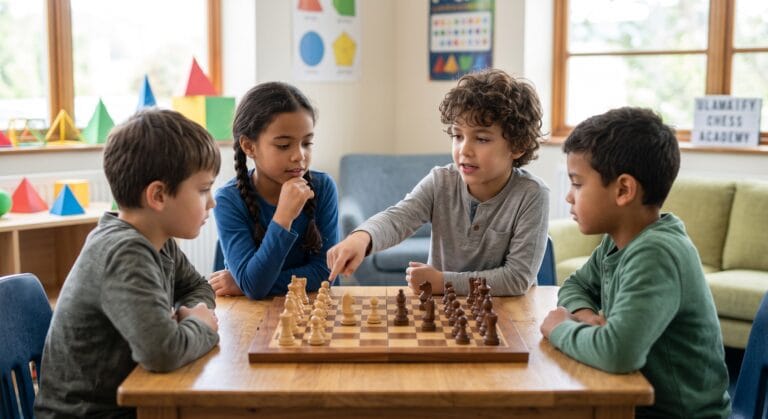
A team activity can require cooperation and adjustment.
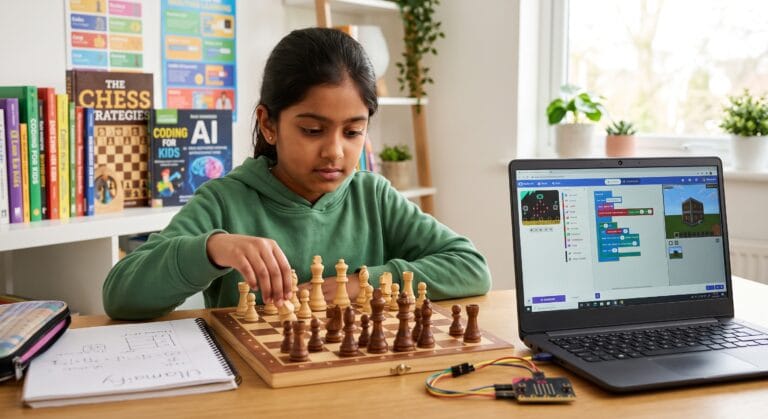
Coding can require debugging and logical sequencing.
Chess can require observation, calculation, restraint, planning, and reflection.
The value is not simply the activity itself. It is what the child repeatedly does while participating in it.
Thinking Habits in Children Grow Through Active Practice
There is an important difference between knowing what to do and practicing it.
Most children already know that they should “think before acting.”
But knowing the sentence is not the same as building thinking habits in children.
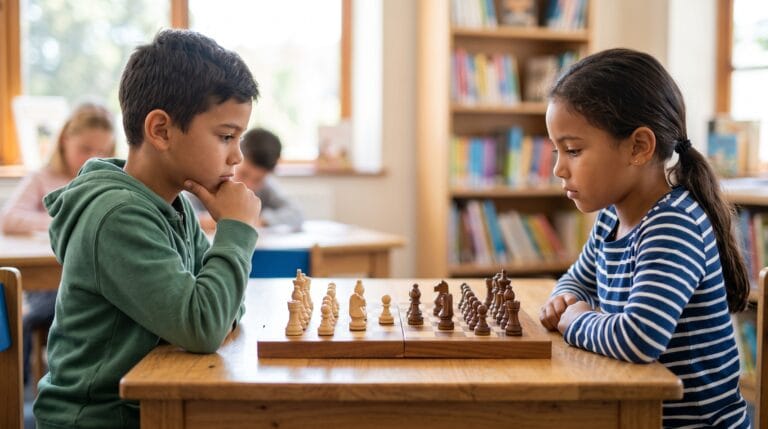
Consider chess.
A child sees an exciting move and reaches for a piece.
Then the coach asks:
“What else could happen?”
Suddenly the child has to stop.
Look again.
Notice the opponent’s idea.
Consider another move.
Predict a consequence.
Then decide.
This is much more active than simply telling a child, “Be thoughtful.”
The chessboard gives the child a reason to practice being thoughtful.
Games Can Give Thinking a Purpose
Children often learn particularly well when a mental skill has an immediate purpose.
Chess provides that naturally.
Working memory matters because the child is trying to remember what they calculated.
Attention matters because an overlooked piece can change the position.
Self-control matters because the first attractive move may not be the best move.
Cognitive flexibility matters because an opponent can suddenly change the situation.
Planning matters because today’s move affects tomorrow’s position.
A 2025 study of 88 children aged five to six compared children who had participated in chess classes with children who had not. The researchers found higher visuospatial working-memory scores in the chess group. Because the study was cross-sectional, it cannot establish that chess alone caused the difference, but it provides an interesting piece of evidence about the relationship between chess participation and executive-function development.
That limitation is important.
Chess should not be marketed as a shortcut to intelligence.
It is better understood as a rich environment in which several forms of thinking are repeatedly required.
Children Need Opportunities to Make Small Decisions
Adults make many decisions for children, and appropriately so.
But children also need safe places to make decisions themselves.
Chess creates hundreds of them.
Should I attack?
Should I defend?
Should I trade?
Should I wait?
Which piece should I improve?
What might my opponent do next?
The consequences are meaningful enough to matter but safe enough to learn from.
A poor decision might cost a pawn.
A rushed decision might lose a queen.
Then the game ends.
The pieces return to their starting squares.
The child gets another opportunity.
That makes chess a small laboratory for decision-making.
Mistakes Can Become Part of Building Thinking Habits in Children
One of the most useful thinking habits a child can develop is not avoiding mistakes.
It is learning what to do after one.
A child who makes a chess mistake can learn to ask:
Where did things begin to go wrong?
What did I overlook?
Was I rushing?
What did my opponent see that I did not?
What should I check next time?
This moves the conversation away from:
“Was I good or bad?”
and toward:
“What can I understand from what happened?”
That is an important distinction.
The mistake becomes information.
Reflection Helps Turn Experience Into Learning
Children can have the same experience repeatedly without necessarily learning from it.
Reflection changes that.
This is why simply playing game after game is not always the same as thoughtful instruction.
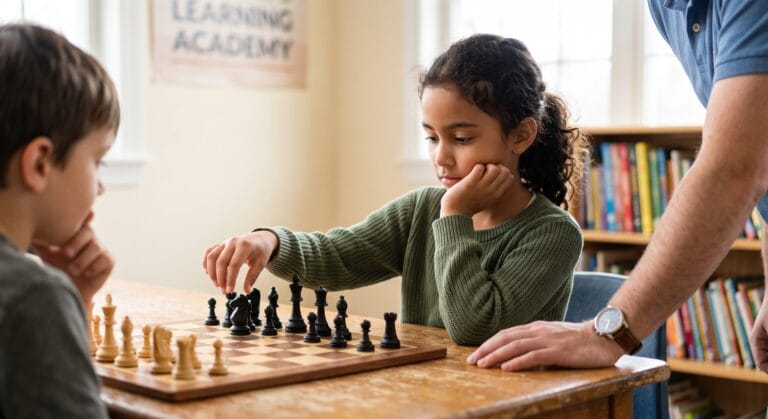
After a game, a good teacher may return to one important position and ask the student to explain their reasoning.
Why did you choose this?
What alternatives did you consider?
What were you expecting?
What actually happened?
Now the student is examining not only the board but also their own thinking.
This is closely related to metacognition: awareness and regulation of one’s own thinking.
Good thinking habits in children are strengthened when they become able to recognize how they reached a decision rather than simply hearing whether the decision was right or wrong.
Parents Can Reinforce Thinking Without Turning Everything Into a Lesson
When developing thinking habits in children, parents do not have to lecture them about executive function.
Often, a question is enough.
Instead of immediately giving an answer:
“What have you tried?”
Instead of fixing the mistake:
“What could you try differently?”
Instead of focusing only on results:
“How did you decide?”
Instead of immediately correcting:
“What else could happen?”
Questions like these place some of the thinking back in the child’s hands.
That is where it belongs.
Why Chess Fits This Stage of Development
Chess is not the only activity capable of encouraging thoughtful behavior.
Reading, coding, sports, music, building, puzzles, art, outdoor exploration, conversation, and many other experiences can make meaningful contributions to childhood development.
Chess has one unusual advantage, however:
Thinking is visible in almost every move.
A child makes a choice.
The position changes.
A consequence appears.
The child receives feedback.
Then another decision begins.
This cycle can happen dozens of times in a single game.
The 2025 research on young chess learners describes chess as requiring players to plan their own activity and anticipate an opponent’s possible moves. The same research cautions that many factors influence executive-function development, which is another reason not to attribute children’s development to one activity alone.
That is a healthier way to understand chess education.
Not:
“Chess will make my child smarter.”
But:
“Chess gives my child another place to practice thinking.”
Why Thinking Habits in Children Matter Beyond Childhood
Eventually, the chessboard becomes more complicated.
So does life.
Children become teenagers.
School assignments become larger.
Projects take longer.
Social situations become more complicated.
Responsibilities increase.
More decisions must be made without an adult standing beside them.
The habits developed earlier can become increasingly useful:
Pause before reacting.
Understand the situation.
Look for alternatives.
Think beyond the immediate moment.
Make a choice.
Examine the result.
Adjust.
Harvard describes planning, focus, self-control, awareness, and flexibility as core capabilities that young people need as they navigate school, relationships, work, and other parts of life.
These abilities are not built by a single chess class, school assignment, conversation, or childhood activity.
They grow through practice.
The Goal Is a Thoughtful Child, Not a Perfect One
Children will still rush.
They will still make poor choices.
They will still forget plans.
They will still become frustrated.
That is childhood.
Building strong thinking habits in children does not mean eliminating mistakes.
It means helping children develop a process they can return to.
At Ulamaify Chess Academy, our version of that process is intentionally simple:
Pause. Observe. Consider. Plan. Move. Reflect.
A child may begin by using those words to choose where a knight should move.
Over time, we hope the larger habit becomes familiar:
Before acting, give yourself a chance to think.
That is why childhood is such a valuable time to build thinking habits in children not because development suddenly stops afterward, but because childhood gives us years of opportunities to practice them.
Research Behind This Article
The Center on the Developing Child at Harvard University explains how executive-function and self-regulation abilities—including planning, attention, working with information, flexibility, and decision-making—develop and can be supported through experience.
A 2025 Frontiers in Psychology study compared executive-function measures in five- and six-year-old children attending chess classes with non-chess-playing peers and found a difference in visuospatial working memory, while appropriately noting the limitations of its cross-sectional design.
For more about how Ulamaify approaches thoughtful chess instruction, visit the Ulamaify Chess Academy.
Why is childhood a good time to build thinking habits?
Childhood and adolescence are periods when abilities such as attention, planning, self-control, working memory, and flexible thinking are still developing.
Ulamaify uses chess during these years as one structured environment where children can repeatedly practice pausing, considering possibilities, making choices, and reflecting on results.
What thinking habits does Ulamaify encourage through chess?
Ulamaify focuses on a simple process:
Pause → Observe → Consider → Plan → Move → Reflect.
The aim is to help children become more familiar with looking carefully, considering alternatives, thinking ahead, making a choice, and learning from what follows.
Why does Ulamaify use active practice instead of only explaining good thinking?
Children may already know they should “think before acting,” but understanding that advice is different from practicing it.
Chess gives Ulamaify coaches real situations where a child must actually stop, examine the board, compare options, choose a move, and see the consequence. The thinking habit is practiced rather than only discussed.
Why is reflection an important part of Ulamaify Chess?
Playing more games does not automatically mean learning more.
Reflection allows a child to return to an important moment and ask what they noticed, what they expected, what changed, and what they might try differently next time.
At Ulamaify, reflection helps turn experience into the next learning step.
How can parents support the thinking habits children practice at Ulamaify?
Parents do not need to teach chess or provide the answers.
Simple questions such as “What have you tried?”, “What other option could you consider?”, or “What do you think might happen next?” can encourage children to do more of the thinking themselves.
Is chess the only way children can develop these thinking habits?
No. Reading, coding, sports, music, puzzles, building, creative projects, and many other activities can also provide valuable thinking practice.
Ulamaify uses chess because every move creates a clear cycle of choice, consequence, feedback, and another opportunity to think, making the thinking process especially visible to both the child and the coach.
Add your first comment to this post