
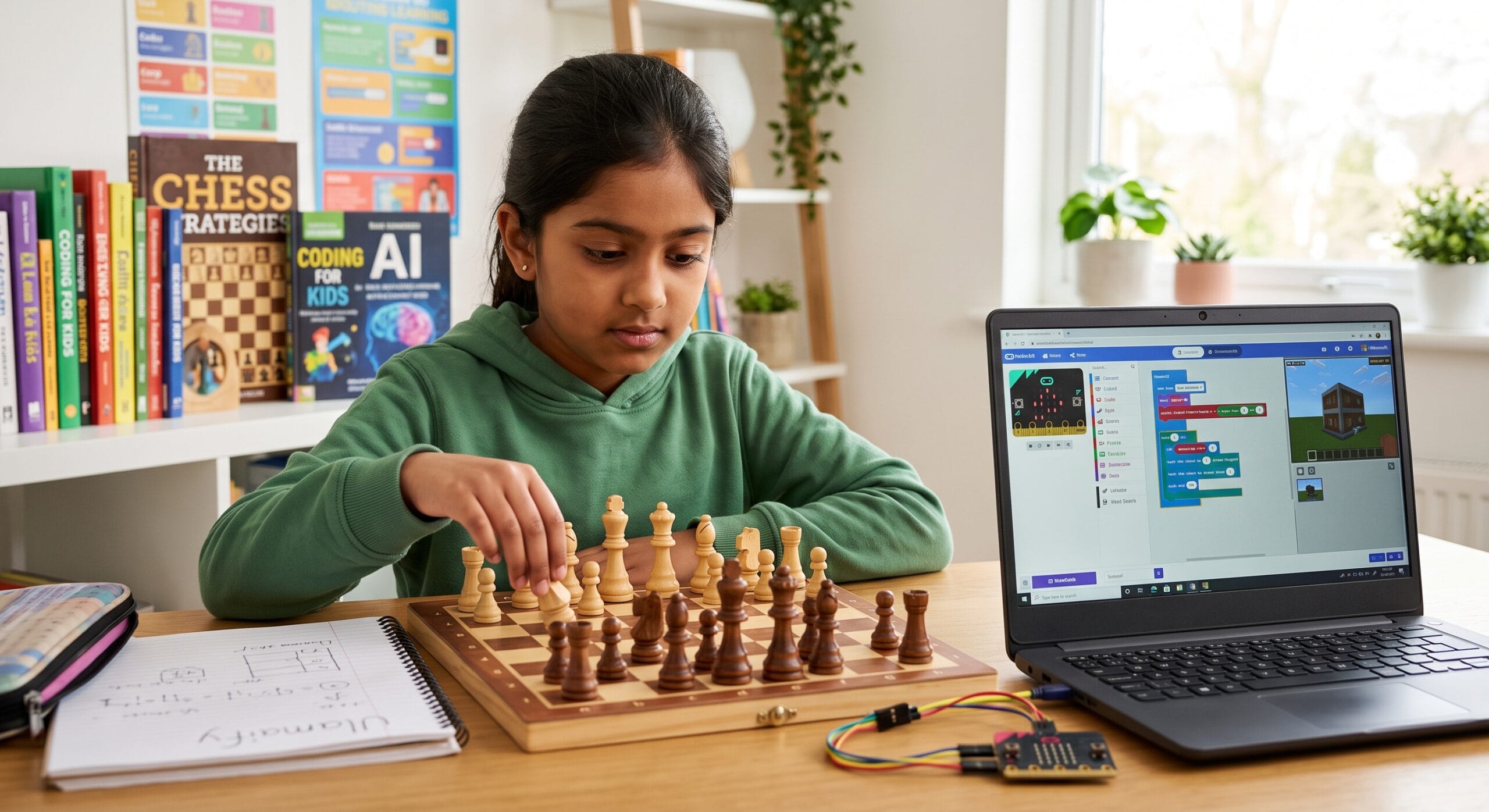
Why Chess and Technology Belong in a Child’s Learning Years: Building Thinkers, Creators, and Problem-Solvers
When considering the benefits of coding and chess for kids, it is important to recognize that children today are growing up surrounded by technology, instant information, entertainment, and increasingly powerful artificial intelligence.
For parents, the question is no longer simply, “How much screen time should my child have?”
A more useful question may be:
“What is my child learning to do with that time?”
There is an important difference between spending an hour passively consuming digital content and spending that same hour solving a coding problem, desigåning a game, debugging a program, analyzing a chess position, creating an animation, or building something inside Minecraft Education.
Chess and technology education may look very different on the surface, but they have something important in common: both can place children in situations where they must stop, think, experiment, make decisions, encounter mistakes, and try again.
That kind of practice matters during childhood and adolescence.
It does not mean chess will automatically make a child a mathematics genius, or that learning Python will guarantee a future career in artificial intelligence. Research does not support claims that simple.
The stronger case is also the more meaningful one: children need opportunities to practice thinking, creating, solving problems, and becoming comfortable with difficult tasks while their cognitive and self-regulation abilities are still developing.
Childhood and Adolescence Are Not Years to Simply Wait Through
A child’s ability to plan, control impulses, hold information in mind, shift between strategies, and stay focused develops gradually.
Researchers commonly group several of these abilities under the term executive function.
The Center on the Developing Child at Harvard describes executive function as involving three core capacities: working memory, mental flexibility, and self-control. Together, these abilities help people manage information, make decisions, remain focused, plan, and adjust when circumstances change.
And development does not stop when children leave elementary school.
Research on adolescent brain development shows that cognitive-control systems and areas of the brain involved in planning, decision-making, and impulse control continue developing throughout adolescence.
That makes childhood and the teenage years important periods for practice.
Children are not simply collecting facts during these years. They are also developing habits for approaching uncertainty:
- What do I do when I don’t immediately know the answer?
- Can I stay with a difficult problem?
- Can I reconsider my first idea?
- Can I learn from a mistake without giving up?
- Can I break a large problem into smaller pieces?
- Can I explain why I made a particular decision?
Those habits cannot be developed by explanation alone.
Children need opportunities to use them.
The Value of “Exercise for the Mind”
Parents often hear phrases such as “brain training” or “mental exercise.” These ideas need to be treated carefully.
There is no single game or activity proven to universally increase intelligence.
In fact, research on cognitive training shows that improvement often transfers most strongly to abilities similar to those being practiced; broad improvements in unrelated skills are much harder to establish.
But that does not mean cognitive practice is meaningless.
Research reviewed by developmental psychologist Adele Diamond has found that children’s executive functions can respond to various forms of structured practice and progressively challenging activities. An important principle is that children need continued challenge rather than simply repeating tasks they have already mastered.
This gives parents a useful way to think about enrichment.
The goal should not be to find a magical “brain game.”
Instead, look for activities that repeatedly require children to:
pay attention → remember information → make a decision → see the result → adjust → try again.
Chess can do this.
Programming can do this.
Design can do this.
Building a Minecraft coding project can do this.
Creating an AI project can do this.
The specific activity matters—but the quality of engagement and instruction matters even more.
Why Chess?
A Chessboard Creates a Natural Thinking Laboratory
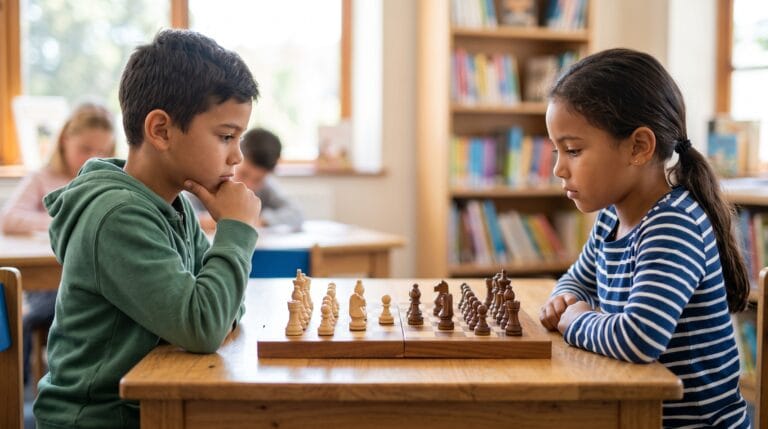
Chess has an unusual characteristic: every move is a decision with a consequence.
A child cannot simply move a piece and expect the board to remain unchanged.
Before moving, the student can learn to ask:
What is happening now?
What might my opponent do?
What are my options?
What happens if I choose this move?
What did I miss?
That creates repeated practice in observation, planning, calculation, inhibition, and reflection.
Chess also gives children immediate feedback.
A plan works.
A piece gets trapped.
An opportunity is missed.
A student wins.
A student loses.
Then another game begins.
The value is not that children never make mistakes. It is precisely that chess gives them a safe environment in which mistakes can be examined.
What Does the Research Actually Say About Chess?
This is an area where responsible education providers should avoid exaggeration.
A 2016 meta-analysis found that chess instruction was associated with moderate improvements in children’s mathematical, reading, and cognitive outcomes. However, the researchers also warned that many studies had methodological weaknesses, including the absence of active control groups.
More rigorous research has sometimes produced smaller or no academic effects. For example, large randomized research examining chess instruction found no convincing improvement in mathematics, reading, or science achievement simply from receiving chess instruction.
Later work has continued to describe the evidence for broad academic transfer from chess as mixed rather than settled.
That is important.
Parents should be skeptical of promises such as:
“Chess will raise your child’s IQ.”
or:
“Chess guarantees better mathematics grades.”
Those claims go beyond the evidence.
But chess does directly require children to practice activities such as planning moves, remembering positions, considering alternatives, inhibiting impulsive choices, recognizing patterns, and solving problems.
Research also shows an association between chess skill and several cognitive abilities, although an association does not prove that chess alone created those abilities.
So the best reason to teach chess is not because it magically transfers into every school subject.
It is because thinking is built into the activity itself.
A thoughtful chess lesson can repeatedly ask a child to slow down and reason before acting.
That is worthwhile practice.
Why Coding?
Coding Changes a Child From a Technology Consumer Into a Creator
Children do not need to become professional programmers for coding education to be valuable.
Programming teaches a way of approaching problems.
A child who writes a program learns very quickly that a computer does not understand what they meant.
It follows what they actually instructed it to do.
When the program fails, the student has to investigate:
What happened?
Where did the logic go wrong?
What should happen first?
Can I divide this problem into smaller pieces?
Can I reuse part of my solution?
That process is central to computational thinking.
Computational thinking includes skills such as decomposition, algorithmic thinking, pattern recognition, abstraction, testing, and debugging. Reviews of programming education consistently identify these as important components of learning to code.
Coding Can Support Skills Beyond Typing Code
A broad meta-analysis of research on learning computer programming found positive transfer to several cognitive areas, with the strongest effects generally occurring for skills more closely related to programming itself. Subsequent reviews have reported positive relationships with areas including problem-solving, creative thinking, mathematical thinking, and reasoning, although the degree of transfer varies considerably among studies and instructional approaches.
Research with younger learners also suggests that children can begin developing computational-thinking concepts well before advanced mathematics or text-based programming becomes appropriate.
This is why a six-year-old and a sixteen-year-old do not need to learn technology in the same way.
A younger child might begin by arranging visual blocks to make a character move.
Later, that same student may use:
Scratch → block coding → Python → APIs → data → artificial intelligence projects.
The tools become more sophisticated, but the underlying habit remains:
Think of an idea. Break it down. Build it. Test it. Fix it. Improve it.
But What If the Coding Happens Inside Minecraft?
Playful Learning Can Still Be Serious Learning
Parents sometimes hesitate when they see Minecraft connected to a course.
“Is my child actually learning—or just playing?”
The answer depends entirely on how Minecraft is being used.
Minecraft Education is not simply ordinary Minecraft with a teacher watching.
Microsoft maintains a structured computer-science progression within Minecraft Education. Its official resources take learners from introductory Hour of Code and Hour of AI experiences into MakeCode block programming and then Python. Microsoft also provides courses such as Coding Fundamentals, GameCode, Python 101, Python Islands, AI-learning experiences, cybersecurity activities, and other structured educational content.
For example, Microsoft’s official Python 101 pathway contains ten lessons covering programming concepts including syntax, data types, variables, conditionals, loops, lists, and functions.
GameCode places coding concepts inside game-design challenges, while Minecraft Education’s broader computer-science curriculum explicitly progresses students from blocks toward Python.
The game environment becomes the context for the problem.
A child might need to program an Agent to construct something.
The Agent does the wrong thing.
Now there is a reason to debug.
A loop builds twelve blocks instead of ten.
Now there is a reason to examine the loop.
A game needs a score.
Now there is a reason to understand a variable.
The learning objective becomes connected to something the child can immediately see.
Engagement Is Not the Enemy of Learning
Children do not have to be bored for an activity to be educational.
In fact, one of the opportunities provided by environments such as Minecraft, Scratch, and game-based coding is that abstract ideas can be connected to visible outcomes.
The key distinction is between:
playing without a learning objective
and
learning through play with intentional challenges, instruction, reflection, and progression.
A structured Minecraft Education class should not merely give a child an hour to wander around a Minecraft world.
It should ask them to solve, code, explain, build, test, and improve.
That is when a familiar game can become a learning environment.
Why Children Need Both Technical Skills and Thinking Skills: The Core Benefits of Coding and Chess for Kids
The future will not belong simply to people who know how to use the newest application.
Applications change.
Programming languages change.
AI systems change.
What remains valuable is the ability to learn unfamiliar systems and solve unfamiliar problems.
This is where chess and technology complement each other particularly well.
Chess teaches a child to look ahead.
Programming teaches a child to break a problem down.
Chess asks:
“What could happen if I make this choice?”
Coding asks:
“What will happen if the computer executes this instruction?”
Chess makes mistakes visible on the board.
Coding makes mistakes visible when the program fails.
Both activities can teach an important lesson:
A mistake is information.
Instead of:
“I got it wrong, so I can’t do this.”
the learning process can become:
“That didn’t work. What happened, and what should I change?”
That shift matters far beyond a chessboard or computer screen.
Why Start During Childhood and the Teenage Years?
Children do not have to choose a career at age eight.
The purpose of early exposure is not to turn every child into a software engineer, AI researcher, chess master, or graphic designer.
It is to give them opportunities to discover:
What am I interested in?
What am I good at?
What is difficult for me?
Can I learn something that initially feels impossible?
Do I enjoy building things?
Do I enjoy strategy?
Do I enjoy solving technical problems?
Adolescence remains a period of substantial cognitive development, including continued maturation of systems involved in cognitive control and decision-making.
Waiting until university to give a young person their first meaningful experience with coding, AI, design, or computational thinking may mean waiting unnecessarily.
Early exposure does not require early specialization.
A child can explore.
They can try chess.
Then Scratch.
Then Minecraft coding.
Then Python.
Then AI.
Then discover that graphic design is actually what excites them most.
Exploration itself has value.
Why Choose Ulamaify?
Technology alone does not teach a child.
A chessboard does not teach a child.
Minecraft does not teach a child.
Python does not teach a child.
The learning environment around the tool matters.
That principle is at the center of how Ulamaify is being built.
1. Small Enough for the Instructor to Notice the Child
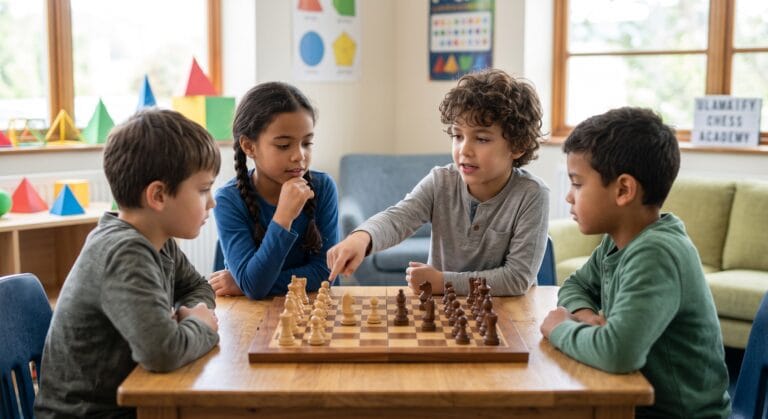
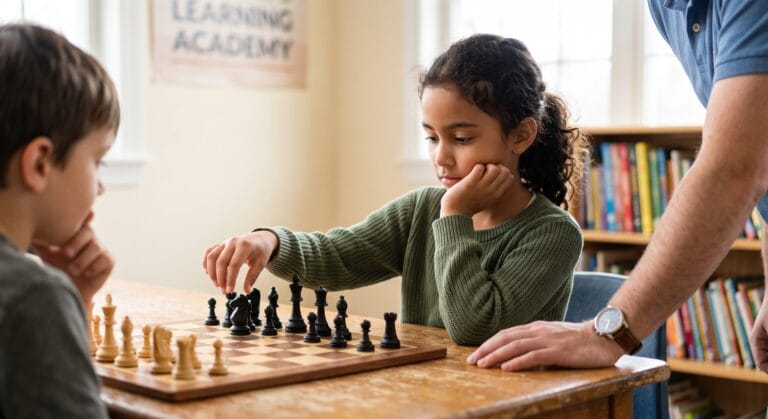
Ulamaify’s Chess Academy uses live small-group instruction with no more than four students, rather than placing children in a crowded webinar or leaving them alone with prerecorded material.
The reason is simple.
An instructor should be able to notice:
- where a child became confused,
- why they chose an answer,
- whether they are participating,
- whether the material is too easy,
- whether the student needs another explanation,
- and whether they are ready for a greater challenge.
The same philosophy carries into Ulamaify’s technology programs, with personalized formats including one-on-one instruction and carefully limited small groups, depending on the program.
2. Children Participate Instead of Simply Watching
Ulamaify is designed around active learning.
In chess, students solve positions, explain ideas, play, analyze, and reflect. The current Chess Academy describes its classes as live and interactive rather than prerecorded.
Technology courses follow the same principle.
Students should not spend an entire lesson watching an instructor write code.
They should be building.
A Scratch student creates the animation.
A Minecraft student programs the Agent.
A Python student writes the function.
A graphic-design student creates the poster.
An AI student develops the project.
The instructor guides the process—but the student does the thinking.
3. Structured Curricula Instead of Random Activities
Fun activities are valuable, but isolated activities do not automatically create a learning pathway.
For Minecraft Education, Ulamaify’s planned program follows official Microsoft Minecraft Education curriculum content and guidelines, including pathways through block coding, Python, Hour of Code, Hour of AI, GameCode, Coding Fundamentals, Python 101, Python Islands, and other Microsoft learning experiences.
Microsoft itself structures its computer-science resources as a progression from introductory coding toward MakeCode Blocks and Python, with additional AI-literacy and digital-citizenship content.
That gives instructors a strong educational foundation while still allowing lessons to be adapted to individual students.
4. Projects Give Learning a Purpose
A child remembers more than a command when that command helped them make something.
That is why Ulamaify’s technology programs are being designed around projects.
Students can move from:
learning a concept → practicing it → applying it → creating something with it.
Instead of learning a Python loop only because “loops are in the curriculum,” a student might use the loop to automate part of a project.
Instead of learning variables as vocabulary, they use a variable to keep score in a game.
Instead of discussing AI only theoretically, they eventually build AI-related projects and investigate how data and algorithms affect results.
The objective is not simply to complete lessons.
It is to gradually become capable of creating more independently.
5. Tournaments and Challenges Create Something to Work Toward
Learning also benefits from meaningful goals.
Ulamaify’s Chess Academy includes tournament opportunities, guided practice, and game analysis in addition to lessons.
The Minecraft Education program is likewise being designed to include regular tournaments and challenges.
Other Ulamaify programs can connect through the broader Creator League, where students can participate in projects, challenges, competitions, showcases, and collaborative experiences over time.
A tournament or challenge changes the question from:
“Do I have to practice?”
to:
“Can I get ready for this?”
For many children, having something to prepare for makes progress feel real.
6. Technology With Responsibility, Not Technology for Technology’s Sake
Children growing up with AI need more than instructions for opening an AI application.
They need to learn to ask:
Where did this answer come from?
Could it be wrong?
What information should I not share?
Is this my work or the AI’s work?
Is this result fair?
Should a human verify this?
Microsoft’s current Minecraft Education computer-science resources themselves increasingly integrate AI literacy, digital citizenship, cybersecurity, and human oversight alongside coding.
Ulamaify’s Python for AI and AI Projects pathways are being designed with the same principle: students should learn not only what AI can do, but how to use it thoughtfully and responsibly.
The Goal Is Not More Screen Time. It Is Better Use of Time.
Parents are right to think carefully about technology.
Children already have screens around them.
The solution is not necessarily adding another hour of passive digital consumption.
But an hour spent creating, coding, debugging, discussing, designing, planning, or solving is fundamentally different from an hour of endless scrolling.
The goal should be to move children gradually from:
consumer → participant → problem-solver → creator.
Chess can turn a quiet board into a laboratory for decisions.
Scratch can turn colorful blocks into a child’s first program.
Minecraft can turn a favorite game into an environment for algorithms, Python, AI, and engineering challenges.
Python can turn instructions into functioning software.
Graphic design can turn an idea into visual communication.
AI projects can turn curiosity about artificial intelligence into an opportunity to understand and build with it.
Different children will connect with different entry points.
What matters is giving them the opportunity to discover one.
A More Useful Question for Parents
Perhaps the question is not:
“Will chess make my child smarter?”
or:
“Will learning Python guarantee my child a technology career?”
No responsible educator can promise either.
A better question is:
“What kinds of habits do I want my child practicing while they are growing?”
Do we want them practicing immediate reaction—or thoughtful decisions?
Passive consumption—or active creation?
Avoiding mistakes—or learning from them?
Waiting for answers—or investigating problems?
Giving up when something fails—or debugging and trying again?
Those habits are developed gradually.
And childhood gives us years in which to practice them.
Give Them Something Worth Thinking About
Children do not need every minute of their lives scheduled.
They need rest.
They need physical activity.
They need friendships.
They need free play.
They need family.
And they also need opportunities to encounter meaningful intellectual challenges.
Chess and technology education can be part of that balance.
Not because every child must become a chess champion.
Not because every child must become a programmer.
But because every child will grow into a world where the ability to think carefully, learn continuously, solve unfamiliar problems, understand technology, and create rather than merely consume will matter.
At Ulamaify, that is the larger purpose behind the courses.
Give children something interesting enough to capture their curiosity, challenging enough to make them think, and supportive enough that they are willing to keep trying.
The chessboard, the code editor, the Minecraft world, or the AI project is only where the journey begins.
The real goal is the thinker and creator who develops along the way.
References & Further Reading
Center on the Developing Child, Harvard University — Executive Function
Research explaining working memory, mental flexibility, self-control, and the development of executive-function skills.
Diamond, A. — Executive Function Development and Interventions
Reviews of activities and programs associated with improvements in children’s executive-function abilities.
Kassai et al. — Executive Function Training and Transfer
Meta-analysis examining near- and far-transfer effects of executive-function training in children.
National Academies — The Promise of Adolescence
Evidence concerning adolescent brain development, executive functioning, cognitive control, and decision-making.
Sala & Gobet — Chess Instruction and Cognitive/Academic Skills
Meta-analysis examining whether chess instruction transfers to mathematical, reading, and cognitive outcomes.
Islam et al. — Effects of Chess Instruction
Research providing a more cautious perspective on claims that chess instruction automatically improves school achievement.
Scherer, Siddiq & Sánchez Viveros — Programming and Cognitive Transfer
Meta-analytic research examining cognitive benefits associated with learning computer programming.
Minecraft Education — Computer Science Curriculum
Official Microsoft/Minecraft Education resources progressing students through Hour of Code, MakeCode Blocks, Python, GameCode, AI literacy, and other computer-science experiences.
Minecraft Education — Python 101
Official ten-lesson Python learning progression covering syntax, data types, variables, conditionals, loops, lists, and functions.
Ulamaify Chess Academy
Current Ulamaify program information describing live coaching, four-student maximum groups, guided practice, tournaments, and progress-oriented instruction.
Children today are growing up surrounded by technology, instant information, entertainment, and increasingly powerful artificial intelligence.
For parents, the question is no longer simply, “How much screen time should my child have?”
A more useful question may be:
“What is my child learning to do with that time?”
There is an important difference between spending an hour passively consuming digital content and spending that same hour solving a coding problem, designing a game, debugging a program, analyzing a chess position, creating an animation, or building something inside Minecraft Education.
Chess and technology education may look very different on the surface, but they have something important in common: both can place children in situations where they must stop, think, experiment, make decisions, encounter mistakes, and try again.
That kind of practice matters during childhood and adolescence.
It does not mean chess will automatically make a child a mathematics genius, or that learning Python will guarantee a future career in artificial intelligence. Research does not support claims that simple.
The stronger case is also the more meaningful one: children need opportunities to practice thinking, creating, solving problems, and becoming comfortable with difficult tasks while their cognitive and self-regulation abilities are still developing.
Childhood and Adolescence Are Not Years to Simply Wait Through
A child’s ability to plan, control impulses, hold information in mind, shift between strategies, and stay focused develops gradually.
Researchers commonly group several of these abilities under the term executive function.
The Center on the Developing Child at Harvard describes executive function as involving three core capacities: working memory, mental flexibility, and self-control. Together, these abilities help people manage information, make decisions, remain focused, plan, and adjust when circumstances change.
And development does not stop when children leave elementary school.
Research on adolescent brain development shows that cognitive-control systems and areas of the brain involved in planning, decision-making, and impulse control continue developing throughout adolescence.
That makes childhood and the teenage years important periods for practice.
Children are not simply collecting facts during these years. They are also developing habits for approaching uncertainty:
- What do I do when I don’t immediately know the answer?
- Can I stay with a difficult problem?
- Can I reconsider my first idea?
- Can I learn from a mistake without giving up?
- Can I break a large problem into smaller pieces?
- Can I explain why I made a particular decision?
Those habits cannot be developed by explanation alone.
Children need opportunities to use them.
The Value of “Exercise for the Mind”
Parents often hear phrases such as “brain training” or “mental exercise.” These ideas need to be treated carefully.
There is no single game or activity proven to universally increase intelligence.
In fact, research on cognitive training shows that improvement often transfers most strongly to abilities similar to those being practiced; broad improvements in unrelated skills are much harder to establish.
But that does not mean cognitive practice is meaningless.
Research reviewed by developmental psychologist Adele Diamond has found that children’s executive functions can respond to various forms of structured practice and progressively challenging activities. An important principle is that children need continued challenge rather than simply repeating tasks they have already mastered.
This gives parents a useful way to think about enrichment.
The goal should not be to find a magical “brain game.”
Instead, look for activities that repeatedly require children to:
pay attention → remember information → make a decision → see the result → adjust → try again.
Chess can do this.
Programming can do this.
Design can do this.
Building a Minecraft coding project can do this.
Creating an AI project can do this.
The specific activity matters—but the quality of engagement and instruction matters even more.
Why Chess?
A Chessboard Creates a Natural Thinking Laboratory
Chess has an unusual characteristic: every move is a decision with a consequence.
A child cannot simply move a piece and expect the board to remain unchanged.
Before moving, the student can learn to ask:
What is happening now?
What might my opponent do?
What are my options?
What happens if I choose this move?
What did I miss?
That creates repeated practice in observation, planning, calculation, inhibition, and reflection.
Chess also gives children immediate feedback.
A plan works.
A piece gets trapped.
An opportunity is missed.
A student wins.
A student loses.
Then another game begins.
The value is not that children never make mistakes. It is precisely that chess gives them a safe environment in which mistakes can be examined.
What Does the Research Actually Say About Chess?
This is an area where responsible education providers should avoid exaggeration.
A 2016 meta-analysis found that chess instruction was associated with moderate improvements in children’s mathematical, reading, and cognitive outcomes. However, the researchers also warned that many studies had methodological weaknesses, including the absence of active control groups.
More rigorous research has sometimes produced smaller or no academic effects. For example, large randomized research examining chess instruction found no convincing improvement in mathematics, reading, or science achievement simply from receiving chess instruction.
Later work has continued to describe the evidence for broad academic transfer from chess as mixed rather than settled.
That is important.
Parents should be skeptical of promises such as:
“Chess will raise your child’s IQ.”
or:
“Chess guarantees better mathematics grades.”
Those claims go beyond the evidence.
But chess does directly require children to practice activities such as planning moves, remembering positions, considering alternatives, inhibiting impulsive choices, recognizing patterns, and solving problems.
Research also shows an association between chess skill and several cognitive abilities, although an association does not prove that chess alone created those abilities.
So the best reason to teach chess is not because it magically transfers into every school subject.
It is because thinking is built into the activity itself.
A thoughtful chess lesson can repeatedly ask a child to slow down and reason before acting.
That is worthwhile practice.
Why Coding?
Coding Changes a Child From a Technology Consumer Into a Creator
Children do not need to become professional programmers for coding education to be valuable.
Programming teaches a way of approaching problems.
A child who writes a program learns very quickly that a computer does not understand what they meant.
It follows what they actually instructed it to do.
When the program fails, the student has to investigate:
What happened?
Where did the logic go wrong?
What should happen first?
Can I divide this problem into smaller pieces?
Can I reuse part of my solution?
That process is central to computational thinking.
Computational thinking includes skills such as decomposition, algorithmic thinking, pattern recognition, abstraction, testing, and debugging. Reviews of programming education consistently identify these as important components of learning to code.
Coding Can Support Skills Beyond Typing Code
A broad meta-analysis of research on learning computer programming found positive transfer to several cognitive areas, with the strongest effects generally occurring for skills more closely related to programming itself. Subsequent reviews have reported positive relationships with areas including problem-solving, creative thinking, mathematical thinking, and reasoning, although the degree of transfer varies considerably among studies and instructional approaches.
Research with younger learners also suggests that children can begin developing computational-thinking concepts well before advanced mathematics or text-based programming becomes appropriate.
This is why a six-year-old and a sixteen-year-old do not need to learn technology in the same way.
A younger child might begin by arranging visual blocks to make a character move.
Later, that same student may use:
Scratch → block coding → Python → APIs → data → artificial intelligence projects.
The tools become more sophisticated, but the underlying habit remains:
Think of an idea. Break it down. Build it. Test it. Fix it. Improve it.
But What If the Coding Happens Inside Minecraft?
Playful Learning Can Still Be Serious Learning
Parents sometimes hesitate when they see Minecraft connected to a course.
“Is my child actually learning—or just playing?”
The answer depends entirely on how Minecraft is being used.
Minecraft Education is not simply ordinary Minecraft with a teacher watching.
Microsoft maintains a structured computer-science progression within Minecraft Education. Its official resources take learners from introductory Hour of Code and Hour of AI experiences into MakeCode block programming and then Python. Microsoft also provides courses such as Coding Fundamentals, GameCode, Python 101, Python Islands, AI-learning experiences, cybersecurity activities, and other structured educational content.
For example, Microsoft’s official Python 101 pathway contains ten lessons covering programming concepts including syntax, data types, variables, conditionals, loops, lists, and functions.
GameCode places coding concepts inside game-design challenges, while Minecraft Education’s broader computer-science curriculum explicitly progresses students from blocks toward Python.
The game environment becomes the context for the problem.
A child might need to program an Agent to construct something.
The Agent does the wrong thing.
Now there is a reason to debug.
A loop builds twelve blocks instead of ten.
Now there is a reason to examine the loop.
A game needs a score.
Now there is a reason to understand a variable.
The learning objective becomes connected to something the child can immediately see.
Engagement Is Not the Enemy of Learning
Children do not have to be bored for an activity to be educational.
In fact, one of the opportunities provided by environments such as Minecraft, Scratch, and game-based coding is that abstract ideas can be connected to visible outcomes.
The key distinction is between:
playing without a learning objective
and
learning through play with intentional challenges, instruction, reflection, and progression.
A structured Minecraft Education class should not merely give a child an hour to wander around a Minecraft world.
It should ask them to solve, code, explain, build, test, and improve.
That is when a familiar game can become a learning environment.
Why Children Need Both Technical Skills and Thinking Skills
The future will not belong simply to people who know how to use the newest application.
Applications change.
Programming languages change.
AI systems change.
What remains valuable is the ability to learn unfamiliar systems and solve unfamiliar problems.
This is where chess and technology complement each other particularly well.
Chess teaches a child to look ahead.
Programming teaches a child to break a problem down.
Chess asks:
“What could happen if I make this choice?”
Coding asks:
“What will happen if the computer executes this instruction?”
Chess makes mistakes visible on the board.
Coding makes mistakes visible when the program fails.
Both activities can teach an important lesson:
A mistake is information.
Instead of:
“I got it wrong, so I can’t do this.”
the learning process can become:
“That didn’t work. What happened, and what should I change?”
That shift matters far beyond a chessboard or computer screen.
Why Start During Childhood and the Teenage Years?
Children do not have to choose a career at age eight.
The purpose of early exposure is not to turn every child into a software engineer, AI researcher, chess master, or graphic designer.
It is to give them opportunities to discover:
What am I interested in?
What am I good at?
What is difficult for me?
Can I learn something that initially feels impossible?
Do I enjoy building things?
Do I enjoy strategy?
Do I enjoy solving technical problems?
Adolescence remains a period of substantial cognitive development, including continued maturation of systems involved in cognitive control and decision-making.
Waiting until university to give a young person their first meaningful experience with coding, AI, design, or computational thinking may mean waiting unnecessarily.
Early exposure does not require early specialization.
A child can explore.
They can try chess.
Then Scratch.
Then Minecraft coding.
Then Python.
Then AI.
Then discover that graphic design is actually what excites them most.
Exploration itself has value.
Why Choose Ulamaify?
Technology alone does not teach a child.
A chessboard does not teach a child.
Minecraft does not teach a child.
Python does not teach a child.
The learning environment around the tool matters.
That principle is at the center of how Ulamaify is being built.
1. Small Enough for the Instructor to Notice the Child
Ulamaify’s Chess Academy uses live small-group instruction with no more than four students, rather than placing children in a crowded webinar or leaving them alone with prerecorded material.
The reason is simple.
An instructor should be able to notice:
- where a child became confused,
- why they chose an answer,
- whether they are participating,
- whether the material is too easy,
- whether the student needs another explanation,
- and whether they are ready for a greater challenge.
The same philosophy carries into Ulamaify’s technology programs, with personalized formats including one-on-one instruction and carefully limited small groups, depending on the program.
2. Children Participate Instead of Simply Watching
Ulamaify is designed around active learning.
In chess, students solve positions, explain ideas, play, analyze, and reflect. The current Chess Academy describes its classes as live and interactive rather than prerecorded.
Technology courses follow the same principle.
Students should not spend an entire lesson watching an instructor write code.
They should be building.
A Scratch student creates the animation.
A Minecraft student programs the Agent.
A Python student writes the function.
A graphic-design student creates the poster.
An AI student develops the project.
The instructor guides the process—but the student does the thinking.
3. Structured Curricula Instead of Random Activities
Fun activities are valuable, but isolated activities do not automatically create a learning pathway.
For Minecraft Education, Ulamaify’s planned program follows official Microsoft Minecraft Education curriculum content and guidelines, including pathways through block coding, Python, Hour of Code, Hour of AI, GameCode, Coding Fundamentals, Python 101, Python Islands, and other Microsoft learning experiences.
Microsoft itself structures its computer-science resources as a progression from introductory coding toward MakeCode Blocks and Python, with additional AI-literacy and digital-citizenship content.
That gives instructors a strong educational foundation while still allowing lessons to be adapted to individual students.
4. Projects Give Learning a Purpose
A child remembers more than a command when that command helped them make something.
That is why Ulamaify’s technology programs are being designed around projects.
Students can move from:
learning a concept → practicing it → applying it → creating something with it.
Instead of learning a Python loop only because “loops are in the curriculum,” a student might use the loop to automate part of a project.
Instead of learning variables as vocabulary, they use a variable to keep score in a game.
Instead of discussing AI only theoretically, they eventually build AI-related projects and investigate how data and algorithms affect results.
The objective is not simply to complete lessons.
It is to gradually become capable of creating more independently.
5. Tournaments and Challenges Create Something to Work Toward
Learning also benefits from meaningful goals.
Ulamaify’s Chess Academy includes tournament opportunities, guided practice, and game analysis in addition to lessons.
The Minecraft Education program is likewise being designed to include regular tournaments and challenges.
Other Ulamaify programs can connect through the broader Creator League, where students can participate in projects, challenges, competitions, showcases, and collaborative experiences over time.
A tournament or challenge changes the question from:
“Do I have to practice?”
to:
“Can I get ready for this?”
For many children, having something to prepare for makes progress feel real.
6. Technology With Responsibility, Not Technology for Technology’s Sake
Children growing up with AI need more than instructions for opening an AI application.
They need to learn to ask:
Where did this answer come from?
Could it be wrong?
What information should I not share?
Is this my work or the AI’s work?
Is this result fair?
Should a human verify this?
Microsoft’s current Minecraft Education computer-science resources themselves increasingly integrate AI literacy, digital citizenship, cybersecurity, and human oversight alongside coding.
Ulamaify’s Python for AI and AI Projects pathways are being designed with the same principle: students should learn not only what AI can do, but how to use it thoughtfully and responsibly.
The Goal Is Not More Screen Time. It Is Better Use of Time.
Parents are right to think carefully about technology.
Children already have screens around them.
The solution is not necessarily adding another hour of passive digital consumption.
But an hour spent creating, coding, debugging, discussing, designing, planning, or solving is fundamentally different from an hour of endless scrolling.
The goal should be to move children gradually from:
consumer → participant → problem-solver → creator.
Chess can turn a quiet board into a laboratory for decisions.
Scratch can turn colorful blocks into a child’s first program.
Minecraft can turn a favorite game into an environment for algorithms, Python, AI, and engineering challenges.
Python can turn instructions into functioning software.
Graphic design can turn an idea into visual communication.
AI projects can turn curiosity about artificial intelligence into an opportunity to understand and build with it.
Different children will connect with different entry points.
What matters is giving them the opportunity to discover one.
A More Useful Question for Parents
Perhaps the question is not:
“Will chess make my child smarter?”
or:
“Will learning Python guarantee my child a technology career?”
No responsible educator can promise either.
A better question is:
“What kinds of habits do I want my child practicing while they are growing?”
Do we want them practicing immediate reaction—or thoughtful decisions?
Passive consumption—or active creation?
Avoiding mistakes—or learning from them?
Waiting for answers—or investigating problems?
Giving up when something fails—or debugging and trying again?
Those habits are developed gradually.
And childhood gives us years in which to practice them.
Give Them Something Worth Thinking About
Children do not need every minute of their lives scheduled.
They need rest.
They need physical activity.
They need friendships.
They need free play.
They need family.
And they also need opportunities to encounter meaningful intellectual challenges.
Chess and technology education can be part of that balance.
Not because every child must become a chess champion.
Not because every child must become a programmer.
But because every child will grow into a world where the ability to think carefully, learn continuously, solve unfamiliar problems, understand technology, and create rather than merely consume will matter.
At Ulamaify, that is the larger purpose behind the courses.
Give children something interesting enough to capture their curiosity, challenging enough to make them think, and supportive enough that they are willing to keep trying.
The chessboard, the code editor, the Minecraft world, or the AI project is only where the journey begins.
The real goal is the thinker and creator who develops along the way.
References & Further Reading
Center on the Developing Child, Harvard University — Executive Function
Research explaining working memory, mental flexibility, self-control, and the development of executive-function skills.
Diamond, A. — Executive Function Development and Interventions
Reviews of activities and programs associated with improvements in children’s executive-function abilities.
Kassai et al. — Executive Function Training and Transfer
Meta-analysis examining near- and far-transfer effects of executive-function training in children.
National Academies — The Promise of Adolescence
Evidence concerning adolescent brain development, executive functioning, cognitive control, and decision-making.
Sala & Gobet — Chess Instruction and Cognitive/Academic Skills
Meta-analysis examining whether chess instruction transfers to mathematical, reading, and cognitive outcomes.
Islam et al. — Effects of Chess Instruction
Research providing a more cautious perspective on claims that chess instruction automatically improves school achievement.
Scherer, Siddiq & Sánchez Viveros — Programming and Cognitive Transfer
Meta-analytic research examining cognitive benefits associated with learning computer programming.
Minecraft Education — Computer Science Curriculum
Official Microsoft/Minecraft Education resources progressing students through Hour of Code, MakeCode Blocks, Python, GameCode, AI literacy, and other computer-science experiences.
Minecraft Education — Python 101
Official ten-lesson Python learning progression covering syntax, data types, variables, conditionals, loops, lists, and functions.
Ulamaify Chess Academy
Current Ulamaify program information describing live coaching, four-student maximum groups, guided practice, tournaments, and progress-oriented instruction.
Add your first comment to this post